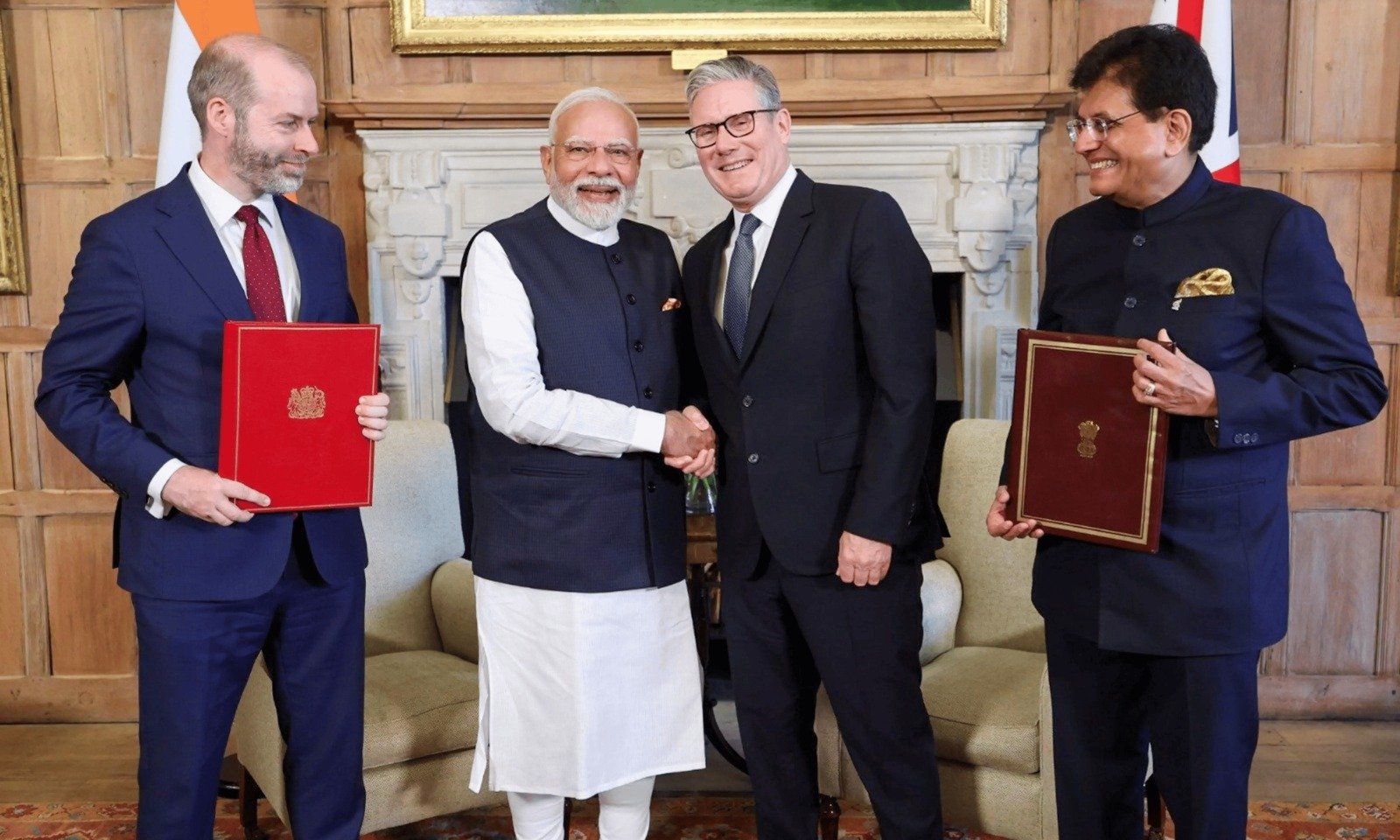
The India–United Kingdom
Comprehensive Economic and Trade Agreement (CETA),
after a series of rigorous negotiations and extensive ratifications, came into
force on July 15, 2026. More than a bilateral market-access arrangement, the trade
deal represents an institutional framework designed to deepen economic
integration between two complementary economies while responding to an increasingly fragmented global
trading landscape.
Global food systems continue to struggle amidst geopolitical uncertainty, climate-induced production shocks, rising protectionism and growing regulatory bottlenecks. Simultaneously, consumers in advanced economies are placing greater emphasis on sustainability, traceability, food safety and premium product differentiation. Within this evolving environment, comparative advantage is increasingly determined not by low production costs alone, but by a country's capacity to produce high-value, standards-compliant and environmentally sustainable food products.
Figure 1: Strategic Value Dimensions of the India – UK CETA for Transforming India’s Agri – Food Sector
Source: Author’s Analysis
Figure 1 maps the strategic value dimensions of the India–UK CETA for India's agri-food sector by comparing current competitiveness with the expected gains from the Agreement. While market access and tariff liberalisation build upon existing competitive strengths, the greatest transformational potential lies in global value chain integration, sustainability and traceability, and supply chain resilience, where current capabilities remain relatively modest but expected improvements are substantial. Food safety standards and premium product positioning further highlight opportunities to enhance export quality and value addition. The distribution of strategic priorities suggests that the Agreement extends beyond tariff reductions, serving as a catalyst for structural upgrading, regulatory alignment, and deeper integration into high-value global agri-food markets, thereby strengthening India's long-term export competitiveness.
India–UK Economic Relations: Institutionalising a Strategic Partnership
Economic relations between India and the United Kingdom have undergone a profound transformation over the past decade. Once shaped primarily by historical and cultural linkages, bilateral engagement is now increasingly driven by trade, technology, investment, innovation and services integration. Following the United Kingdom's withdrawal from the European Union, both governments identified the need for a dedicated bilateral framework capable of preserving commercial continuity while unlocking new avenues for economic cooperation.
This relationship has expanded steadily despite periods of global economic disruption. Bilateral trade in goods and services reached approximately £43.8 billion in 2024, almost tripling from £15.9 billion in 2015, illustrating the resilience and growing strategic importance of the economic partnership. During 2025–26 alone, India exported goods worth US$13.44 billion to the United Kingdom while importing goods valued at US$11.68 billion, maintaining a merchandise trade balance.
Source: UK Government, India Trade and Investment Fact Sheet, 23 June 2026
The FTA institutionalises this deepening economic relationship by providing a predictable, rules-based framework that strengthens market integration.Under the agreement, the United Kingdom immediately eliminates tariffs on 96.8 per cent of tariff lines, covering approximately 97.7 per cent of India's exports by value, while India liberalises 64.1 per cent of tariff lines upon entry into force, with additional tariff reductions implemented progressively over the coming decade. This asymmetrical liberalisation reflects India's calibrated approach towards protecting sensitive domestic sectors while simultaneously securing substantial export opportunities in a high-income market.
Figure 3: Estimated Long Run Impact of the India – UK free trade agreement
Source: UK Government, India–UK free trade agreement Impact Assessment 2025
The UK Government's equilibrium modelling suggests that the India–UK FTA will fundamentally strengthen bilateral trade, with total trade projected to expand by 39%. The disparity between projected UK export and import growth indicates that the magnitude of benefits will ultimately depend on each country's capacity to exploit new market access and enhance export competitiveness.
Repositioning India's Agri-Food Sector within Global Value Chains
The agricultural implications of the agreement extend far beyond tariff preferences.
For decades, India's export performance has been constrained not by inadequate production capacity but by limited participation in high-value segments of global food markets. Although India enjoys significant comparative advantages across commodities such as rice, spices, tea, marine products, fruits and processed foods, export earnings have frequently been constrained by low levels of value addition, fragmented supply chains and inconsistent quality standards.
The United Kingdom presents a fundamentally different commercial environment. As one of the world's most sophisticated food-importing economies, British demand is increasingly driven by premiumisation, sustainability and consumer trust. Retail procurement decisions are shaped as much by traceability, food safety and environmental credentials as by price competitiveness. Consequently, success within this market requires exporters to compete on quality, reliability and compliance rather than volume alone.
This demand profile corresponds closelywith India's evolving agricultural capabilities. Products such as Basmati Rice, Darjeeling Tea,speciality spices, coffee, marine products, processed foods, ready-to-eat meals and fruit preparations already possess established market recognition among British consumers. Preferential tariff treatment strengthens their relative competitiveness against suppliers from countries without comparable trade arrangements, enabling Indian exporters to expand market share while simultaneously encouraging investments in branding, packaging and product differentiation.
Figure 4: Projected India Agri–Food Exports to the UK under Alternative FTA Utilisation Scenarios (2026–2031)
Source: DGFT (2025); APEDA (2025); UN Comtrade (2025)
Figure 4 illustrates the projected trajectory of India's exports to the United Kingdom under three post-FTA utilisation scenarios between 2026 and 2031. Historical exports increased steadily from USD 1.86 billion in 2018 to USD 4.62 billion in 2025, reflecting the strengthening of bilateral commercial ties even prior to the Agreement. The scenario analysis demonstrates that the extent of FTA utilisation will be the principal determinant of future export performance. Under a baseline scenario with no significant FTA effect, exports are projected to reach only USD 5.93 billion by 2031. In contrast, moderate utilisation of the Agreement raises exports to USD 7.50 billion, while high utilisation could increase exports to nearly USD 9.0 billion, representing a cumulative export gain of more than USD 3 billion over the baseline. The widening divergence across the three scenarios highlights that the Agreement, in itself, does not guarantee higher trade outcomes. Rather, the magnitude of export gains will depend on effective implementation, firm-level utilisation of preferential market access, regulatory compliance, supply-chain competitiveness, and sustained policy support. The projections therefore reinforce that the India–UK FTA should be viewed not merely as a tariff-liberalisation instrument, but as a strategic framework whose economic returns will ultimately be determined by India's capacity to translate market access into sustained export competitiveness.
Competitiveness will be Determined beyond the Borders
While tariff liberalisation has attracted considerable public attention, the long-term commercial value of the India–UK FTA will be determined by factors that extend well beyond customs duties. Contemporary agricultural trade is increasingly shaped by non-tariff measures (NTMs), regulatory harmonisation and supply-chain governance. In advanced food markets such as the United Kingdom, the principal barriers to trade are no longer high tariffs but stringent standards governing food safety, traceability, sustainability and consumer protection.
For Indian exporters, this fundamentally changes the nature of export competitiveness. Preferential tariffs reduce the cost of market entry, but they do not guarantee market access. Compliance with Sanitary and Phytosanitary (SPS) measures, maximum residue limits (MRLs), animal and plant health protocols, food labelling requirements and traceability systems will determine whether Indian products can consistently penetrate British retail supply chains.
This distinction is particularly significant because India's experience with previous Free Trade Agreements has demonstrated that negotiated tariff concessions often remain underutilised. Limited awareness of compliance requirements, fragmented certification mechanisms and inadequate institutional capacity have historically constrained exporters from fully leveraging preferential agreements. Consequently, the effectiveness of the India–UK FTA will depend as much upon domestic regulatory preparedness as upon the provisions negotiated at the bilateral level.
Equally important are the agreement's Rules of Origin (RoO). Preferential tariff treatment is contingent upon products satisfying prescribed origin criteria, thereby preventing trade diversion while ensuring that the benefits accrue to genuine domestic producers. For Indian exporters, particularly micro, small and medium enterprises (MSMEs), compliance with these provisions will require greater investment in documentation, digital record-keeping and supply-chain transparency. Strengthening institutional support for exporters through simplified certification systems and greater awareness will therefore be essential to maximise utilisation rates.
The Emerging Centrality of Sustainability and Value Addition
The India–UK CETA enters into force at a time when international food trade is undergoing a profound transformation. Sustainability, once regarded as a voluntary commercial attribute, has increasingly evolved into a strategic determinant of competitiveness. British consumers and retailers are placing growing emphasis on environmentally sustainable production, ethical sourcing, carbon accountability and responsible supply-chain governance. Consequently, tariff preferences alone are unlikely to sustain long-term export growth if they are not accompanied by demonstrable improvements in environmental and social performance.
This changing market landscape presents India with an opportunity to redefine the composition of its agricultural exports. Rather than competing primarily through low-cost production, Indian firms can increasingly differentiate themselves through premium branding, Geographical Indication (GI) products, organic certification and value-added processing. Such a transition would not only improve export earnings but also strengthen resilience against commodity price volatility by shifting producers towards higher-value market segments.
The agreement is therefore expected to stimulate investment across multiple layers of the agricultural economy. Expansion of food processing industries, modern packaging facilities, integrated cold-chain infrastructure, accredited testing laboratories and digital traceability platforms would enhance both domestic productivity and export competitiveness. These investments generate positive spillover effects extending beyond trade by reducing post-harvest losses, improving farm-gate price realisation and creating employment across rural and peri-urban regions.
Furthermore, the agreement reinforces the importance of Farmer Producer Organisations (FPOs) and agricultural cooperatives. As international markets increasingly demand consistency, quality assurance and traceability, producer aggregation becomes indispensable. Well-functioning FPOs can enable smallholders to access export markets that would otherwise remain beyond their commercial reach, thereby improving inclusivity within India's export ecosystem.
Policy Priorities for Maximising the Agreement's Potential
The commercial opportunities created by the FTA will materialise only if accompanied by complementary domestic reforms. A preferential trade agreement cannot, in isolation, compensate for structural inefficiencies within production systems or export infrastructure. Instead, it should be viewed as a catalyst that magnifies the returns from effective domestic policy interventions.
The projected outcomes highlight several policy imperatives that will determine the Agreement's long-term effectiveness.
First, strengthening India's quality infrastructure must become a national priority. Investments in internationally accredited laboratories, digital certification systems and harmonised inspection mechanisms will reduce compliance costs while improving exporter confidence.
Second, export competitiveness requires sustained investment in logistics and post-harvest infrastructure. Efficient cold-chain networks, multimodal transport systems and modern warehousing remain essential for reducing spoilage and ensuring timely delivery of perishable agricultural products.
Third, institutional capacity building will be equally important. Many exporters, particularly MSMEs and farmer collectives, continue to face informational barriers regarding Rules of Origin, SPS requirements and certification procedures. Expanding technical assistance, exporter outreach programmes and digital trade facilitation platforms will therefore be essential to improving utilisation of the agreement.
Table 1: Expected Competitive position of Indian Agri-Food products in UK Market after CETA
Source: ICT, India–UK Free Agreement Impact Assessment 2025
Note: Consumer demand is assessed based on current market trends in U.K. Outlook reflects expected prospects for Indian Agri – Food sector in the post CETA scenario.
Conclusion
The operationalisation of the India–UK Free Trade Agreement marks a defining moment in India's evolving trade policy architecture. It reflects a broader transformation in India's approach to international economic engagement, one that increasingly recognises competitiveness, resilience and value creation as the principal objectives of trade policy.
For the agri-food sector, the agreement offers an opportunity to move beyond the traditional paradigm of commodity-led export growth. Preferential market access to one of the world's most sophisticated consumer markets provides the commercial incentive to strengthen food processing, improve quality assurance, enhance supply-chain efficiency and expand the production of premium agricultural products. Yet these opportunities will remain largely aspirational unless supported by sustained domestic reforms and institutional preparedness.
Ultimately, the India–UK FTA should be understood less as a tariff agreement and more as a framework for structural transformation. Its long-term significance will not be measured by the volume of bilateral trade alone, but by its capacity to accelerate the evolution of India's agricultural economy from one characterised by comparative advantage in production to one distinguished by competitive advantage in quality, innovation and value addition.
As global food systems become increasingly shaped by sustainability, regulatory compliance and sophisticated consumer preferences, the agreement provides India with a strategic platform to reposition itself within international agri-food value chains. Whether that opportunity translates into enduring export leadership will depend not on the provisions contained within the agreement itself, but on the policy choices, institutional investments and private-sector innovation that follow its implementation.