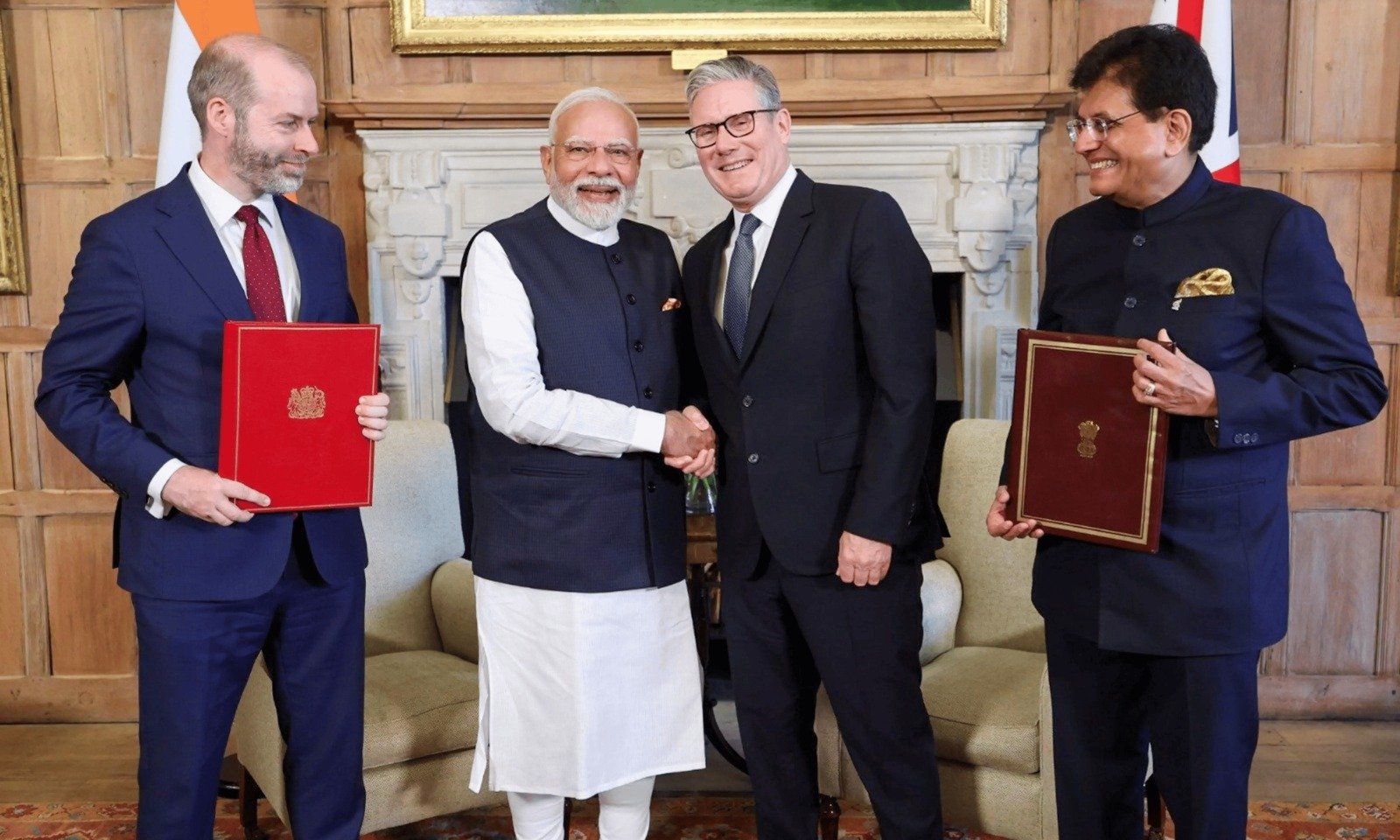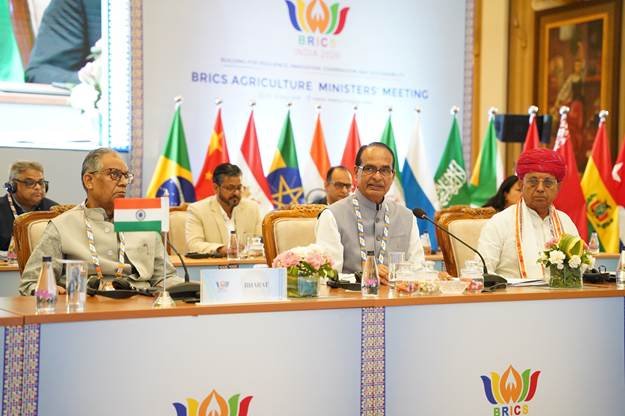
The Indore
Declaration was unanimously adopted on June 13, 2026, marking the end of the
16th BRICS Agriculture Ministers' Meeting in Indore. A systematic commitment by
eleven member countries, each with different farming landscapes, political
systems, and economic development levels, to realign global agriculture towards
food security, sustainable farming, digital innovation, and smallholder
welfare.
Rather than simply
functioning as a mere communiqué of good intentions, the Declaration
establishes four concrete institutional platforms. Each framework is assigned a
lead nation or institution designed to transition multilateral cooperation from
ministerial discussion rooms directly to actual farms.
|
BRICS Agriculture at a
Glance (2026) |
|
|
BRICS
member countries |
11 nations |
|
Share
of world population |
~47% |
|
Share
of global agricultural land |
~42% |
|
Share
of global food-grain production |
~42% |
|
Delegates
at 16th ministers' meeting |
~100 (60 from BRICS/partner) |
|
Meeting
chair & location |
Shri Shivraj Singh Chouhan; Indore, MP |
“At
a time of global crisis and uncertainties, the BRICS meeting has sent a strong
message of hope, trust and collective responsibilit to the world.”— Shri
Shivraj Singh Chouhan, Union Minister of Agriculture and Farmers Welfare
Four
Priority Areas of the Indore Declaration
BRICS Network of Centres
of Excellence on Agro-Ecology and Regenerative Agriculture
will promote joint research, knowledge sharing, and capacity building in
natural, organic, and regenerative farming. India’s Indian Institute of Farming
Systems Research, Modipuram, will serve as a Centre of Excellence.
BRICS Network on Digital
Agriculture aims to enhance cooperation in AI,
geospatial technologies, digital public infrastructure, and data-driven
agricultural solutions. IIT Delhi will coordinate the network to support
innovation and farmer welfare.
Global Forum on Farmers’
Rights in Seed Systems will protect farmers’
seed rights, conserve indigenous seed diversity, and preserve traditional
agricultural knowledge for food security and climate resilience.
BRICS AgriN
(Agro Inputs, Genetic Resources and Information Network) will facilitate
information exchange, technical cooperation, and sharing of superior seeds,
genetic resources, and best agricultural practices among BRICS countries.
The Agro-Ecology Network
In
terms of policy, the most impactful structural result is the establishment of a
BRICS Network of Centres of Excellence on Agro-Ecology and Regenerative
Agriculture. This significant initiative will be coordinated by India, through
ICAR–Indian Institute of Farming Systems Research (IIFSR), Modipuram which will
be formally identified as India's "Centre of Excellence on Natural Farming
and Ecologically Sustainable Agricultural Practices".
This
arrangement will integrate India's domestic agricultural programmes, primarily
the National Mission on Natural Farming (NMNF), into a wider multilateral
research framework. By aligning domestic challenges with the BRICS network,
India gains access to significant resources such as-
- Comparative performance
data from BRICS countries that are currently going through similar transitions.
- Regional access to pooled
international research funding sources.
- Global market validation
for naturally produced food from India.
Digital
Agriculture
The
BRICS Network on Digital Agriculture, coordinated by IIT Delhi, aims to fill a
gap in agricultural delivery, specifically in the area of asymmetry of
information. At present, there exists a major imbalance of real-time data
between farmers and traders who purchase their goods, which routinely leads to
the loss of income throughout BRICS.
The
BRICS Network on Digital Agriculture will utilize technologies such as
artificial intelligence, geospatial technologies, Digital Public Infrastructure
(DPI), and data-driven agricultural solutions in order to provide more current
information to farmers, thereby minimizing the information asymmetry.
For
India, this effort will provide a regulatory framework and cooperative
agreement for the greater than 1,200 agri-tech startups in India to jointly
establish and grow their companies in 11 countries. The successful development
of the BRICS Network on Digital Agriculture will provide similar feedback
mechanisms to any agri-tech startup with either a soil sensor or AI model based
on the calibration of India to smallholders in Ethiopia or Soybean to Brazil,
assuming the Knowledge-to-Action Hub is able to provide companies with a
mechanism to translate their information into commercial products and services
as opposed to acting as an inter-governmental archive and subsequently becoming
stalled.
Farmers'
Seed Rights
Protection
of Plant Varieties and Farmers’ Rights Authority (PPV&FRA) in India will
serve as the administering body of the Global Forum on Farmers' Rights (GFFR)
in Seed Systems. The GFFR is focused on three inter-connected issues that
farmers confront: legitimate protection against legal action for farmers who
save, re-use and exchange seeds, the need to conserve localized indigenous seed
diversity, and the right of farmers to protect their traditional agricultural
knowledge from being misappropriated without receiving an agreed upon share of
any benefits derived from that knowledge.
There
are more than 100,000 unique varieties of rice that have been documented in
India and have been passed from generation to generation in India through the
efforts of informal seed-saving farmers rather than being preserved in formal
gene banks. Additionally, these varieties have important traits that provide
critical evolutionary advantages (such as drought tolerance, flood resistance
and pest resistance) that commercial breeding programs are attempting to
re-introduce into contemporary seed crops following a period of genetic narrowing
during which these traits were lost. The Indore Declaration establishes a
unified multi-lateral platform to resist biopiracy and create international
legal precedents regarding farmer rights prior to the next wave of global
genomic patents being entered into the global marketplace.
Trade,
Supply Chains, and Climate Urgency
As
a result of geopolitical conflict disrupting the world grain, sunflower oil and
fertilizer markets, the Declaration puts attention to fragility in agricultural
trade and supply chains on a global scale. In the current BRICS alignment,
Russia is the world's largest supplier of nitrogen-based fertilizers, Brazil is
the largest supplier of soybeans and China commands substantial market shares
of both phosphate and potassium. For India (dependent on imports of potash and
phosphate), having
At
the summit, the ministers reiterated their collective desire for a "fair
and transparent multilateral agricultural trading system." This wording
signifies that BRICS nations are frustrated with the WTO agri negotiations that
have not successfully disciplined Western agricultural subsidy programs.
In
addition, the topic of climate change continued to be at the forefront of the
summit discussions and was a significant point of discussion during the entire
ministerial meeting. Delegates shared protocols for food-loss reduction and
understanding how to prepare for El Niño conditions related to the growing
season.
As
evidenced by the Indian Meteorological Department’s (IMD) seasonal forecast for
2026 predicting an unusually high probability of poor monsoon rainfall across
many major food producing regions, the urgency regarding climate change has
surfaced and poses a direct threat to kharif production. The Indore Declaration
provides a concrete mechanism for coordination through common monitoring and
reporting tools as well as developing early warning data systems, thus allowing
for the beginning of developing institutional climate adaptation mechanisms.
The
Implementation Gap
The
conference is just page 1 of the project, the success lies in the
implementation. Fortunately, the Indore Declaration provides clear
accountability mechanisms: lead institutions are formally named and specific
mandates are defined. The 'Knowledge-to-Action Hub' model is specifically
structured to prevent research from stagnating in academic archives without
reaching actual fields.
Nonetheless,
the gap between diplomatic signing and farm-level deployment remains broad. The
Agro-Ecology Network requires each member country to fund bilateral research,
establish secure data-sharing protocols, and designate national Centres of
Excellence. For India, the ultimate indicator of success will be whether the
NMNF's domestic budget scales up to match its high-profile multilateral
ambitions. Running a global research network while funding natural farming with
less capital than the cost of a two-day chemical fertiliser subsidy remains a
stark paradox.
Conclusion
The Indore Declaration is significant because it marks the first time 11 nations with vastly different agricultural models have collectively committed to an institution backed eco-farming agenda. India's role as coordinator of the flagship agroecology network places internal pressure on its own policy execution. For businesses, traders, and agricultural professionals, the Indore Declaration marks the opening of a critical policy chapter. The implementation track record over the coming years will ultimately reveal whether this framework delivers tangible substance or remains a well-formatted archive.