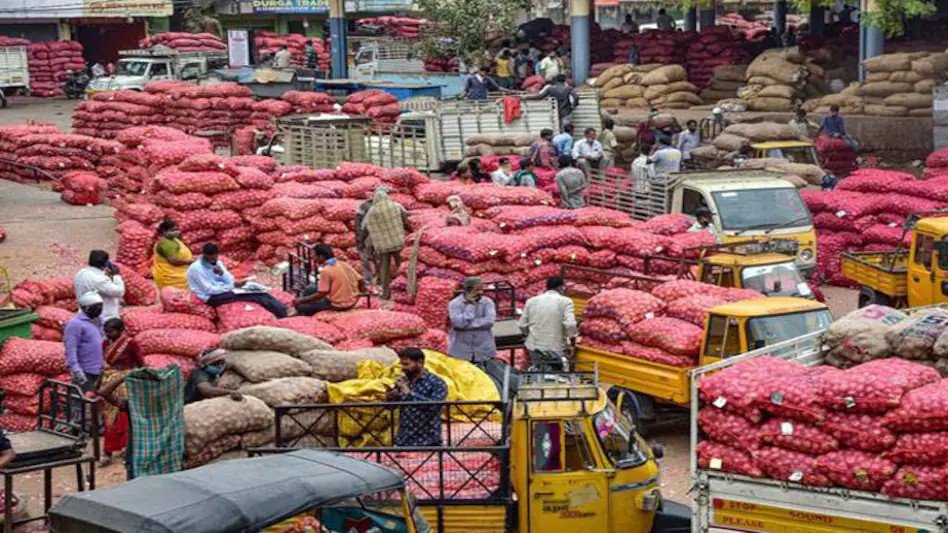
India's agricultural market architecture has been predominantly governed at the state level under individual Agricultural Produce Market Committee (APMC) Acts, creating a structurally fragmented ecosystem of approximately 7,690 regulated mandis — significantly below the National Commission on Farmers' recommendation of 42,000 mandis, or one per 80 square kilometers of arable land. Within this framework, traders also required state-specific licences, market fees are levied at multiple points of transaction, and farmers are legally bound to sell within designated market areas. In Punjab, for instance, cumulative mandi levies on a transaction can exceed 8.5% of the transaction value.
Against this backdrop, the Government of India launched e-NAM on 14 April 2016, implemented by the Small Farmers Agribusiness Consortium (SFAC) under the aegis of MoA&FW. Designed to unify the country's fragmented agricultural market infrastructure into a single digital trading platform, the platform's core objective was to create a pan-India electronic trading portal that would network existing APMC mandis, enable competitive price discovery through transparent e-auctions, reduce intermediary dependence, and critically facilitate both intra-state and interstate trade through a unified digital interface. This initiative operationalized the “One Nation, One Market” vision and represented the most significant structural intervention in India's agricultural marketing system since the Model APMC Act, 2003.
A decade into implementation, a fundamental tension has emerged between the platform's impressive operational metrics and its limited market integration outcomes. This research article analyses that tension through three lenses: the regulatory framework, infrastructure adequacy, and the policy design of the proposed e-NAM 2.0 upgrade.
Operational Scale: What a Decade of Data Shows
A decade into its implementation, e-NAM has achieved significant scale across 23 states and 4 Union Territories, integrating 1,522 mandis, registering 1.79 crore farmers and 2.67 lakh traders, and onboarding 3,551 Farmer Producer Organizations (FPOs), the latter representing the platform's most structurally significant achievement for smallholder market power. Cumulative trade value also crossed ₹4.3 lakh crore, and over 9.6 crore metric tons of produce had been transacted on the platform — yet it continues to function predominantly as a digital overlay on localized physical auctions rather than a genuinely integrated national market. Inter-state trade remains negligible at ₹76.8 crore, representing less than 0.02% of total trade value, and declined sharply by 78% in FY2024–25.
The digitization of auction records and the introduction of real-time price information have materially reduced the information asymmetry that made traditional mandi auctions vulnerable to collusion and systematic underbidding. Survey cited in the Economic Survey 2023–24 found that approximately 66% of farmers across surveyed states considered e-NAM's quality testing procedures to be transparent; a measurable improvement over the opacity of predecessor arrangements. The electronic Negotiable Warehouse Receipt (e-NWR) system has enabled a growing segment of farmers to defer distress sales and transact digitally when prices are more favorable.
Yet several dimensions of this data warrant sober policy attention. The platform's current farmer coverage is estimated at roughly 25% of India's farming households, constrained by the fact that only about 23% of APMCs are integrated. FPO integration at 3,551 against a national government target of 10,000 FPOs indicates that the collective bargaining mechanism for smallholders remains structurally underutilized. And cumulative interstate trade of ₹76.8 crore against a total platform trade value of ₹4.3 lakh crore, which is less than 0.02%, and declining by 78% in FY2024–25, represents not a performance shortfall but a structural failure of the platform's foundational objective. The interstate market has been contracting, not growing, for a decade, showcasing that this is not a technology problem but an institutional one.
The Market Integration Gap and Three Structural Constraints
● APMC Regulatory Heterogeneity
In India, agricultural marketing is a state subject. The effective integration of e-NAM into a genuinely national market, therefore, depends on state-level legislative compliance with three core reform prerequisites: a single trading license valid across the state; a single-point levy of market fee applicable only at the first transaction; and an e-trading and e-auction framework. These are the minimum conditions for a trader in one state to bid meaningfully for produce in another.
The Agricultural Marketing and Farmer Friendly Reform Index (AMFFRI) shows that one-third of states have not notified even these essential reforms. States such as Bihar, Kerala, and Manipur have either partially implemented or bypassed the reform framework entirely, creating a patchwork of their own of market access rules that structurally inhibit interstate digital trade. Due to this, a trader in Rajasthan seeking to purchase wheat from Madhya Pradesh faces potential licensing barriers in both jurisdictions absent reciprocal license recognition — a problem no digital platform can resolve unilaterally.
The repeal of the three central farm laws in December 2021, which had sought to enable trade outside APMC mandis and permit interstate commerce without mandi levies, further consolidated dependence on state-level APMC reform as the primary lever for market integration. This underscores the central policy lesson of e-NAM's first decade: the platform's integration mandate cannot be achieved through platform design alone but requires a coordinated legislative action across state governments, and that action has not materialized at the necessary scale.
● The Quality Assaying Infrastructure Deficit
Remote trade comes with a fundamental trust problem. A buyer procuring grain from a distant mandi relies exclusively on standardized grading and credible assaying to manage quality risk. In the absence of this infrastructure, the rational choice for the buyer is local sourcing, where physical inspection is feasible. This single institutional gap is the proximate cause of e-NAM's interstate trade failure.
Assaying infrastructure is demonstrably uneven across the 1,500+ integrated mandis. Equipment availability, laboratory accreditation, and trained personnel vary significantly across states. Research published in Discover Sustainability (Bora & Gupta, 2025) found that despite 78.43% of surveyed farmers possessing smartphones, many still perceived the online weighing and assaying process as lengthier and riskier than traditional open auctions. This is a rational response to institutional inadequacy, not a technology adoption failure.
The issue is compounded by the absence of standardized grading parameters for all 247 commodities notified on the platform. Quality data reported from one mandi is frequently not comparable with data from another, directly undermining the cross-state price discovery that is the platform's core value proposition. No amount of interface improvement compensates for non-comparable quality signals.
● The Logistics and Post-Harvest Infrastructure Gap
The NABCONS All-India Post-Harvest Loss Survey (2020–22) estimated annual food losses of approximately ₹1.53 lakh crore, with horticulture losses alone reaching 49.9 million metric tons per year, primarily attributable to inadequate cold chain infrastructure. These losses fall disproportionately on smallholder farmers, who account for 85% of India's agricultural households and who lack both the storage capacity and market access to time their sales optimally. The farmer's share of the final consumer price stands at approximately 28%, reflecting the depth of intermediary capture that persists despite a decade of digital market reform.
The structural cause is architectural because, unlike private agri-tech platforms that bundle trade with logistics, cold storage, and quality guarantees, e-NAM currently functions only at the transaction layer. It records and validates bids; it does not facilitate physical fulfilment. Confirmed digital transactions must still be executed through a fragmented, unintegrated physical supply chain. This positions the platform at a structural disadvantage relative to integrated private sector competitors — particularly for high-value perishable commodities — and explains why private agri-tech has consistently attracted higher interstate trade volumes than the national public platform.
State-Level Reform Divergence
The AMFFRI data also reveals a clear correlation between state-level APMC reform adoption and market integration outcomes. High-reform states such as Haryana, Gujarat, and Maharashtra have invested in digital integration and supply chain infrastructure and their mandis record active inter-mandi digital trading with strong buyer participation. The physical market density in these states approximates one mandi per 62 villages across roughly 34,120 hectares of coverage area.
Medium and low-reform states such as Andhra Pradesh, Telangana, and Uttar Pradesh show high unified license adoption but inconsistent assaying and logistics infrastructure. Market density also ranges from 17 to 146 villages per mandi, indicating significant variation in physical accessibility.
Very-low or no-reform states like Bihar, Kerala, and Manipur retain the fragmented market structures with limited e-NAM penetration and constrained price discovery. The policy implications of this divergence are direct: reform adoption, not digital capacity, is the binding constraint on market integration.
e-NAM 2.0: A Sound Architecture, Insufficient Alone
The Government of India is advancing the platform's next phase through e-NAM 2.0, an upgrade built on an open-network architecture aligned with the Open Network for Digital Commerce (ONDC) framework. Its design directly targets the service-layer gap that has constrained the platform since 2016.
The proposed innovations are substantive, and in e-NAM 2.0, third-party assaying firms, logistics providers, and fintech companies will be permitted to integrate as formal service providers on the platform, creating a competitive service marketplace alongside the core trading function. Logistics tie-ups at physical mandis in this key structural update are intended to reduce post-harvest losses in perishable commodities. Automated bidding, Aadhaar-based eKYC, and fintech credit embedding are designed to address the working capital constraints and informal credit obligations that currently anchor smallholder farmers to commission agents. QR-based lot tracking and real-time stakeholder notifications aim to build the provenance transparency that remote buyers require.
The open-network model has the potential to transform e-NAM from a digital ledger of local auctions into a genuine national commerce infrastructure, replicating the service bundling that makes private agri-tech platforms competitive, while preserving the public interest mandate of price transparency and farmer access.
But the upgrade's success will be determined by factors external to the platform. The following are necessary institutional conditions, not optional enhancements.
Harmonization of state APMC legislation — Reciprocal license recognition across state borders and the adoption of single-point market fee levies should be enacted by the remaining one-third of states that have not notified essential reforms. Without this, e-NAM 2.0's open-network architecture will be technically operational but legally inaccessible for the interstate trade.
Mandatory quality standardization — Uniform grading parameters must be notified and enforced for all 247 notified commodities, with third-party assaying accreditation and laboratory infrastructure extended across the integrated mandi network. Assaying should be treated as infrastructure, not as an optional service layer.
Primary Processing Centre expansion — A cluster-based investment program in Primary Processing Centres providing scientific cleaning, grading, and packing at the mandi level is essential to reduce post-harvest losses and enable physical fulfilment of the digital bids e-NAM 2.0 will generate. Without this, the platform will continue to produce unmatched bids and buyer frustration.
Dispute resolution mechanisms — Credible, accessible adjudication pathways for disputes arising from remote transactions are a prerequisite for interstate digital trade at scale. Their absence is a structural barrier to the trust-building that a national market requires.
Policy Recommendations
· Agricultural infrastructure funding should be tied to APMC reform compliance. The central government should establish a performance-linked incentive framework conditioning access to agricultural infrastructure grants on state adoption of the three core APMC reform prerequisites.
· Third-party assaying accreditation needs to be funded and mandated. All e-NAM-integrated mandis should be required to meet a minimum assaying infrastructure standard within a defined timeline, with NABARD and SFAC co-funding accreditation and equipment costs for mandis in low-reform states.
· Expansion of the e-NWR system and linking to formal agricultural credit is due. Extending the electronic Negotiable Warehouse Receipt system to smaller mandis and linking it to Kisan Credit Cards and Primary Agricultural Credit Societies (PACS) would enable smallholder farmers to defer distress sales and deepen market participation. This is among the most structurally transformative instruments available within the existing policy toolkit. Formalize a graduated payment model nationally. The Madhya Pradesh model — part-cash, part-digital payment at the point of mandi transaction should be assessed and adopted through the e-NAM platform to address the informal credit obligations that currently prevent digital payment adoption among smallholders dependent on commission agents for advance credit.
· A comprehensive market density assessment on a district-level gap analysis is overdue. A time-bound infrastructure investment plan targeting the most underserved agricultural regions — particularly in eastern and northeastern India is a prerequisite for physical market access reform.
Conclusion
Ten years after its launch, e-NAM has demonstrably succeeded in its first-phase objective of digitizing India's mandi infrastructure at scale and introducing transparency into price discovery mechanisms that were previously vulnerable to systematic manipulation.
But the data on interstate trade of ₹76.8 crore against ₹4.3 lakh crore in total trade value, declining by 78% in FY2024–25 also indicates that the platform's foundational objective of a unified national agricultural market remains structurally unmet. This gap is institutional in nature and reflects uneven APMC reform adoption across states, inadequate quality assaying infrastructure, the absence of an integrated logistics layer, and the absence of credible dispute resolution for remote transactions.
The e-NAM 2.0 upgrade's open-network architecture offers a technically sound pathway forward. But its success will depend less on the sophistication of its technology than on the political will to harmonize state-level agricultural marketing legislation, invest in physical assaying and cold chain infrastructure, and build the institutional trust mechanisms that interstate digital trade requires at scale.
The decade ahead will not be defined by what the platform can do. It will be defined by whether the regulatory and institutional ecosystem around it is finally ready to let it work.
.jpeg)