
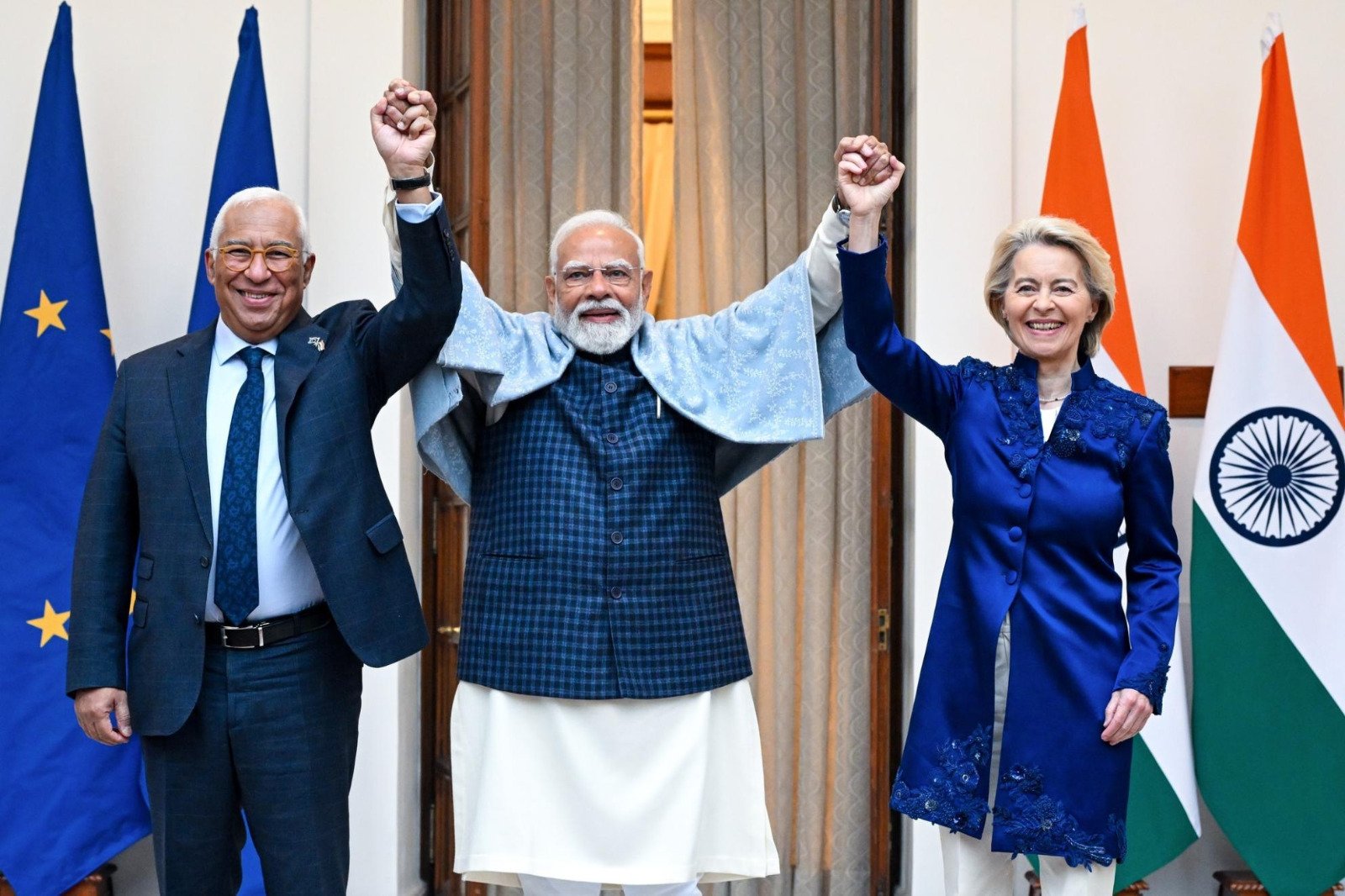
The India-European Union (EU)
Trade Agreement is a landmark free trade agreement that is coming after
almost two decades of its initiation. The agreement covers the traditional
areas like trade in goods, services, trade remedies, rules of origin, customs,
and trade facilitation, as well as emerging areas like SMEs and digital trade,
amongst others.
The India-European Union (EU) Trade Agreement is a landmark free trade agreement that is coming after almost two decades of its initiation. The agreement covers the traditional areas like trade in goods, services, trade remedies, rules of origin, customs, and trade facilitation, as well as emerging areas like SMEs and digital trade, amongst others.
The trade deal, quoted by some as the “Mother of All Trade Deals” has brought together the 2nd & 4th largest economies and aims to unlock an additional 75 billion dollars’ worth of exports as over 99% of Indian export value now enters the EU duty-free category. The agreement has opened the markets of 27 European nations for Indian textile, electronics, chemical, marine, engineering, gems & jewellery, pharmacy & medical device, leather & footwear, and agri-food industries.
This ambitious deal will grant the EU tariff reductions that none of India’s other trading partners have received. The tariffs on imported cars are gradually going down from 1110% to as low as 10%, while they will be fully abolished for car parts after five to ten years. Tariffs ranging up to 44% on machinery, 22% on chemicals and 11% on pharmaceuticals will also be mostly eliminated. This step will give a significant competitive advantage for key EU industrial and agri-food sectors, granting companies privileged access to the world's largest consumer market. Both parties are also dedicated for the formation of a chapter which will also help small India-EU businesses take full advantage of the new export opportunities. As both sides will put in place dedicated contact points to provide SMEs with relevant information on the FTA and help them with any specific issue they would face when trying to use the FTA's provisions. In addition to this, SMEs will also particularly benefit from the tariff reductions, removal of regulatory barriers, transparency, stability, and predictability provided by the Agreement.
EU companies will also receive privileged access to the Indian services market, including key sectors such as financial services and maritime transport. The agreement also provides a high level of protection and enforcement of Intellectual Property (IP) rights, including copyright, trademarks, designs, trade secrets, and plant variety rights. This will make it easier for EU and Indian businesses that rely on IP to trade and invest in each other's markets.
|
Imported Products |
Tariffs before FTA |
Tariffs after FTA |
Remarks |
|
Wine |
Up to 150% |
20-30% (phased manner) |
Significant tariff cut, making it affordable |
|
Spirits (whisky, gin, vodka) |
Up to 150% |
~40% (phased manner) |
Partial liberalisation |
|
Beer |
Around 110% |
~50% |
Moderate tariff reduction |
|
Olive Oil |
Up to 45% |
0% |
Full duty elimination |
|
Other Edible Oils (selected EU varieties) |
30-45% |
0% |
Full liberalisation |
|
Processed foods (pasta, biscuits, bakery items, chocolates) |
30-50% |
0% |
Full duty elimination |
|
Fruit juices & non-alcoholic beverages |
Up to 55% |
0% |
Full liberalisation |
|
Fresh fruits (kiwi, pear – limited lines) |
~30-33% |
5-10% (quota-based) |
Controlled market access |
|
Sheep meat |
~30-33% |
0% |
Niche product, access in limited volumes |
|
Processed meat products (sausages, cured meats) |
Up to 110% |
~50% |
Partial protection and tariff reduction |
India now enjoys preferential access to European markets for over 97% of tariff lines, representing 299.5% of the total trade value. Key labour-intensive industries will have their duties removed for 70.4% of tariff lines, which account for 90.7% of India's exports. Key labour-intensive sectors (such as textiles, apparel, marine, leather, footwear, chemicals, plastics/rubber, sports goods, toys, gems, and jewellery), comprising more than INR 2.87 Lakh Crore (USD 33 billion) of exports that are currently subjected to import duty between 4% to 26% in the EU and are crucial for employment generation, will enter zero duty from entry into force of the FTA and thus gain enhanced competitiveness in the EU market.
For the agri-food industry, a great opportunity lies in boosting competitiveness for agricultural commodities, such as processed foods, tea, coffee, spices, table grapes, gherkins, cucumbers, sheep and lamb meat, sweet corn, dried onions, and other fruit and vegetable products. The reduced/eliminated tariffs on these agricultural products in the EU market will improve the price competitiveness of Indian products vis-à-vis suppliers from Latin America, Africa, and Southeast Asia and will strengthen the export market for Indian products. The FTA ensures that the goods exported under it undergoes adequate processing or manufacturing for them to get the originating status and preferential access.
Further, the FTA will facilitate ease of doing business by reducing the time and associated cost of compliance for Indian exporters by allowing self-certification through a Statement on Origin. The PSRs chart an innovative course by considering the needs of MSMEs by locking in quotas for shrimps & prawns, and downstream aluminium products, which would enable MSMEs to source non-originating inputs. They also incentivise ‘Make in India’ by building a transition period for certain PSRs in the machinery and aerospace sector.
The India-EU FTA comes at a decisive moment when the global market faces increased volatility. The agreement aims to deliver a major boost to India’s agriculture and processed food exports and also safeguard the sensitive sectors such as dairy, cereals, poultry, soy meal, certain fruits and vegetables, etc. The market liberalisation of imported products like alcoholic beverages, edible oils, fruit and fruit juices, lamb, and processed meat products will lead to good market competitiveness and also provide consumers with a range of buying options.